

Navigating Sequence of Returns Risk

Planning for retirement involves not only saving diligently but also strategically managing your investments to ensure a secure financial future. Stock market volatility and inflation are two of several risks that people face when investing for retirement.
These risks raise an important question, “Will my portfolio funds last throughout retirement?” The answer will depend upon certain factors including an often-overlooked risk known as the sequence of returns, which can significantly impact your retirement income.
What is Sequence of Returns Risk?
Mitigating the Risk
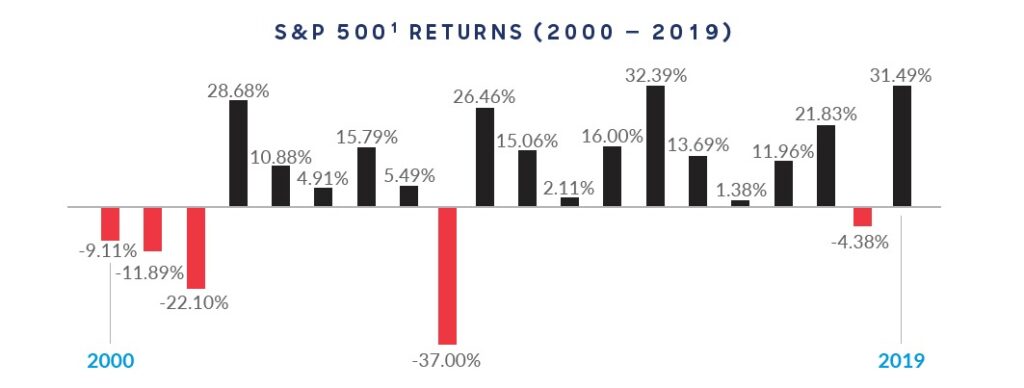
What if You Retired in 2000? *
The average annual return over this period was 7.68%. However, there were two significant market declines. The first started in 2000 with a three-year downturn attributable to the tech-bubble; the second was a large negative return in 2008 as a result of the financial crisis.
What if You Retired in 2000? *
The average annual return over this period was 7.68%. However, there were two significant market declines. The first started in 2000 with a three-year downturn attributable to the tech-bubble; the second was a large negative return in 2008 as a result of the financial crisis.
Annual Retirement Income — $50,000
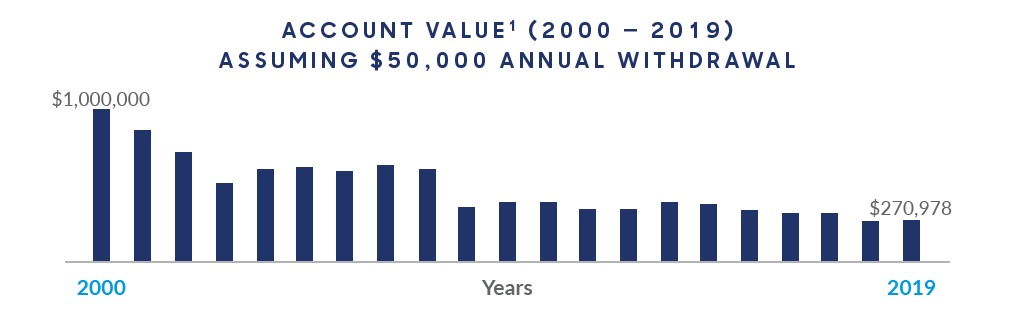
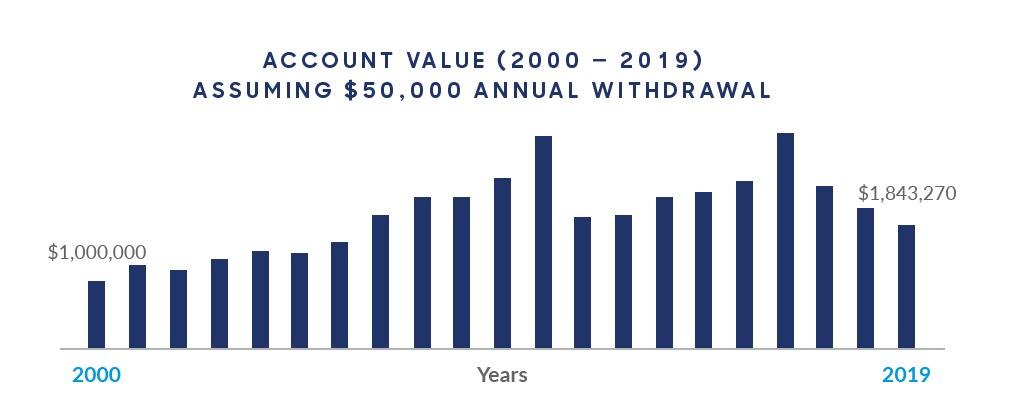
What if you were to withdraw $50,000 from the account at the beginning of each year for 20 years? The following chart shows the year-by-year account value through 2019.
As you can see, the two big market downturns had a long-term impact on the account. Following both declines, the account was never able to fully recover its value. So, after taking $1,000,000 of income out of the account over the 20 years, you are left with about $271,000 at the end of 2019.
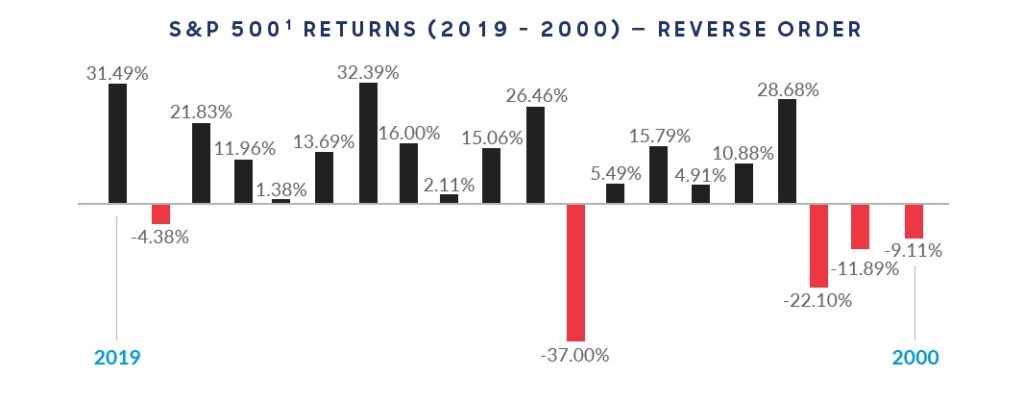
What if We Were to Reverse the Returns?
Let’s look at the same scenario, but this time reverse the order of the S&P returns (2019-2000). In this scenario, the significant negative returns fall in the latter half of the 20-year period.
What if We Were to Reverse the Returns?
Let’s look at the same scenario, but this time reverse the order of the S&P returns (2019-2000). In this scenario, the significant negative returns fall in the latter half of the 20-year period.
Now, let’s suppose you take out the same $50,000 each year for 20 years under this scenario.
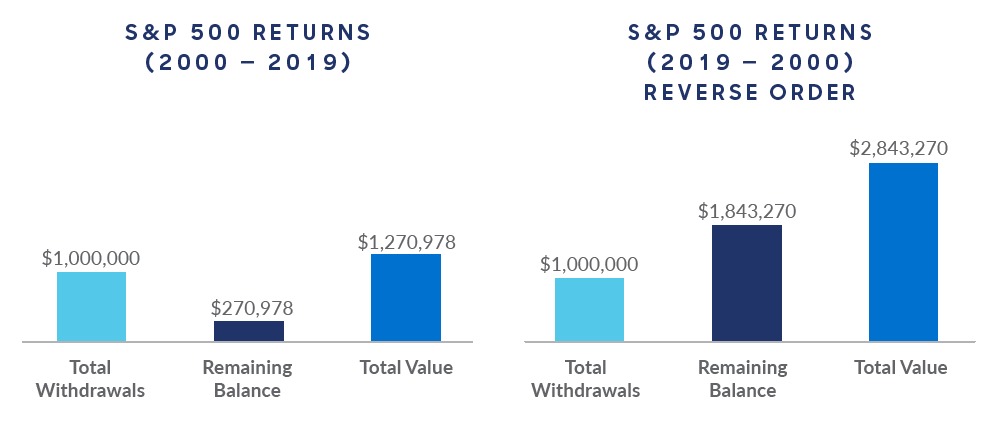
If you withdrew the same $50,000 each year for 20 years, your ending balance would be $1,843,270. You can see the negative returns in this scenario still had a big impact, but the account was able to grow to over $2,000,000 by the time significant market downturns occurred. As a result, you were able to withdraw the income you needed and still ended up with a large account balance.
Summary
The following charts summarize the results under each scenario:
Based on the actual returns from 2000 to 2019, you received all of the income you needed, but only had a remaining balance of $270,978. Assuming those returns were reversed, you withdrew the same $1,000,000, but had a remaining balance of $1,843,270. This is almost seven times more.
This example illustrates the impact that timing of market downturns can have on a retirement portfolio. In order to take advantage of the long-term growth potential that equities and other higher-risk assets offer during retirement, you need to be in a position to weather the economic downturns that impact them over time. Having dependable sources of income that are not directly impacted by short-term disruptions in the financial market can help you reduce the impact of market downturns during retirement. See how a modified income withdrawal strategy can improve your retirement outcome.
Start Planning Now
It is never too soon to begin planning for a secure future. The best time to begin is right now. A financial professional can help you understand retirement risks, clarify your retirement goals, inventory your assets, estimate your retirement expenses, and identify any income gaps.
*Massachusetts Mutual Life Insurance Company (MassMutual), The Impact of Varying Returns on Your Retirement, 2023.
1. The S&P 500 Index is a list of securities frequently used as a measure of U.S. stock market performance. These investment results and account values are hypothetical. They do not reflect fees and charges associated with an actual investment. Had fees and charges been reflected, the values would be lower. You cannot invest directly in an index. Past performance does not guarantee future results.